Whether you need a cleaver in your kitchen depends on your cooking style and meat prep needs. If you often deal with large cuts, bones, or heavy-duty tasks, a cleaver offers power and efficiency. For delicate slicing, trimming, and versatility, a chef’s knife is essential. Both tools complement each other well, so having both can enhance your cooking experience. Keep exploring to discover how to choose the right knives for your kitchen.
Key Takeaways
- A cleaver excels for heavy-duty tasks like breaking bones and large meat cuts, while a chef’s knife is ideal for precise slicing and trimming.
- Having both tools offers versatility, covering all meat preparation needs efficiently in your kitchen.
- Regular maintenance of both knives ensures optimal performance and prolongs their lifespan.
- A cleaver provides power and leverage, reducing wrist strain during tough cuts; a chef’s knife offers finesse for delicate work.
- Including a cleaver in your kitchen is beneficial if you frequently handle large meats or bones, but it’s not essential for everyday cooking.
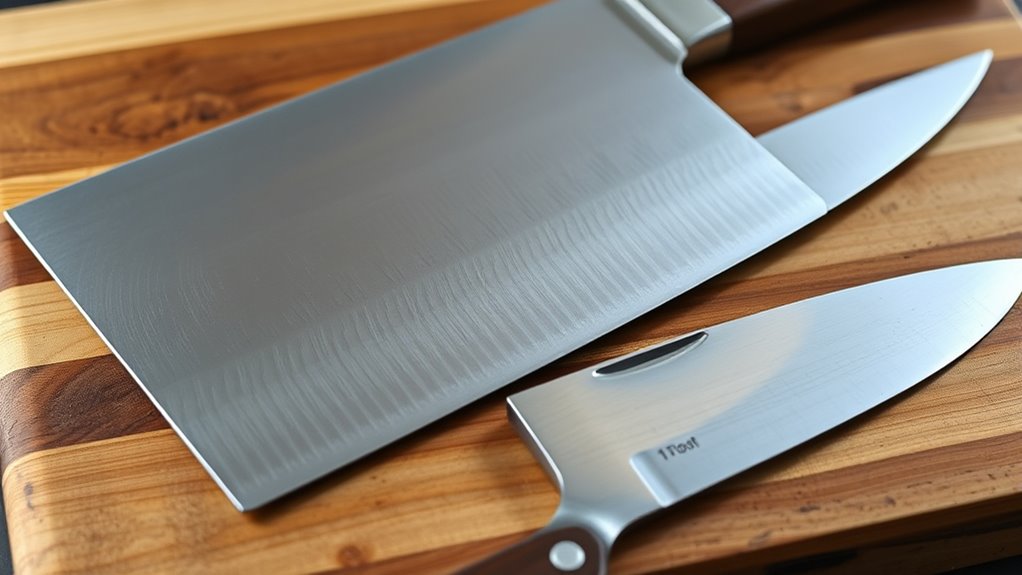
Have you ever wondered which knife is better for your kitchen tasks—the cleaver or the chef’s knife? The answer depends on what you cook most often and how you prefer to handle your kitchen prep. If you regularly work with large cuts of meat or need to break down poultry, a cleaver can be a game-changer. Its broad, heavy blade makes meat preparation quicker and more efficient, allowing you to chop through bones or dense tissue with less effort. On the other hand, if you’re more into fine slicing, dicing, and delicate cuts, a chef’s knife offers precision and control that’s hard to match.
When it comes to meat preparation, each tool has its strengths. A cleaver provides the power needed for heavy-duty tasks, like crushing garlic or hacking through tough joints. Its weight helps you exert force without straining your wrist, making it ideal for butchering or breaking down large pieces of meat. Conversely, a chef’s knife excels at trimming fat, slicing thin steaks, or creating intricate cuts. It allows for more finesse, so you can work carefully and avoid tearing the meat or wasting portions. Ultimately, many cooks find that having both in their kitchen covers all their meat prep needs.
Both cleaver and chef’s knife excel in meat prep, offering power and finesse respectively.
Beyond choosing the right knife, maintaining it properly ensures it stays effective and safe to use. Knife maintenance involves regular honing and occasional sharpening. Honing realigns the blade’s edge, keeping it sharp for everyday tasks, while sharpening removes small nicks and dullness over time. For a cleaver, it’s essential to keep the blade free from rust and corrosion, especially if it’s made from carbon steel. For a chef’s knife, proper storage—like a knife block or magnetic strip—prevents accidental damage to the edge. Hand washing and drying immediately after use also prolong the life of both knives, preventing corrosion and maintaining hygiene.
If you’re considering whether to add a cleaver to your collection, think about your typical cooking routines. Do you often handle large cuts of meat, or do you prefer detailed, precise cuts? The cleaver can do the heavy lifting, but it’s not a substitute for a chef’s knife, which offers versatility and finesse. Proper knife maintenance is essential regardless of your choice, ensuring your tools perform well and last for years. Having both blades in your kitchen can make your cooking more efficient and enjoyable, especially when you understand their unique strengths and how to care for them.

imarku Japanese Chef Knife-Sharp Kitchen Knife 8 Inch, Gift for Mom & Dad
- High-Carbon Stainless Steel Blade: Durable, long-lasting, and twice as hard
- Multi-functional Kitchen Knife: Cuts, dices, slices, and chops
- Ergonomic Pakka Handle: Comfortable, strong, and fatigue-reducing
As an affiliate, we earn on qualifying purchases.
As an affiliate, we earn on qualifying purchases.
Frequently Asked Questions
Can a Chef’s Knife Substitute for a Cleaver?
A chef’s knife can substitute for a cleaver in many tasks, thanks to its versatility, but it’s not ideal for heavy-duty chopping or splitting bones. You’ll benefit from a cleaver’s design if you often handle large, tough cuts. If your kitchen space is limited, a chef’s knife offers a more convenient, multi-purpose option without sacrificing much functionality. For most home cooks, it’s a practical choice, but a cleaver’s still handy for specific tasks.
What Materials Are Best for Cleaver Blades?
You should choose cleaver blades made from high-carbon stainless steel for ideal cutting performance. These blade materials offer durability, corrosion resistance, and sharpness retention, making chopping heavy meats and bones easier. Avoid softer metals that dull quickly. A well-made cleaver with quality blade materials ensures you get the best cutting performance, whether you’re breaking down large cuts of meat or slicing through tough vegetables.
Is a Cleaver Suitable for Delicate Slicing Tasks?
A cleaver isn’t ideal for delicate slicing tasks because its thick, heavy blade is designed for meat preparation and chopping through bones. You’ll find it too bulky for precise vegetable slicing or fine work. For delicate tasks, a chef’s knife or paring knife offers better control and accuracy. Use a cleaver for heavy-duty tasks, but stick with a lighter, sharper knife for delicate slicing to achieve clean, precise cuts.
How Do I Maintain and Sharpen a Cleaver?
Think of your cleaver as a trusted sword in a knight’s hand. To keep its blade sharp and guarantee blade longevity, regularly use a whetstone or a honing rod, applying gentle, consistent strokes. Avoid aggressive sharpening, which can damage the edge. Clean and dry it thoroughly after each use. Proper maintenance through correct sharpening techniques keeps your cleaver formidable, ready for heavy-duty tasks, and preserves its edge for years to come.
Are There Safety Concerns Specific to Cleaver Use?
Yes, there are specific safety concerns when using a cleaver. You should always prioritize knife safety by using proper handling techniques, such as keeping your fingers away from the blade and maintaining a firm grip. Cleavers are heavy and can slip if not handled carefully, so focus on control during cutting. Always use a stable cutting surface, and keep the blade sharp to minimize the risk of accidents caused by slipping.

Mueller 7-Inch Meat Cleaver Butcher Knife, German High Carbon Steel
- Laser-Tested German Steel Edge: Precision-forged high-carbon stainless steel blade
- Razor-Sharp Double-Bevel Blade: 18° angle for durability and sharpness
- Rust and Corrosion Resistant: Resists rust, discoloration, and micro-fractures
As an affiliate, we earn on qualifying purchases.
As an affiliate, we earn on qualifying purchases.
Conclusion
Whether you choose a cleaver or a chef’s knife, your kitchen is about to become a battlefield of culinary mastery. The right tool can turn you into a slicing superhero, slicing through ingredients like a hot knife through butter. Don’t underestimate the power of having both in your arsenal; it’s like wielding a sword and a scalpel in one. With these tools, you’ll conquer any cooking challenge that comes your way—your kitchen will never be the same!

Intelitopia Complete Knife Sharpening Stone Set – Dual Grit Whetstone 400/1000 3000/8000 Knife Sharpener with Leather Strop, Flattening Stone, Bamboo Base, 3 Non-slip Rubber Bases & Angle Guide
- Complete Knife Sharpening Kit: Includes all necessary sharpening tools
- Dual Grit Whetstone: 400/1000 and 3000/8000 grit options
- High-Quality Corundum Stone: Durable aluminum oxide abrasive
As an affiliate, we earn on qualifying purchases.
As an affiliate, we earn on qualifying purchases.

Cook N Home Basics, Acacia Wood Cutlery Storage Block without Knives, Universal Knife Holder Countertop Butcher Block Knife Stand for Easy Kitchen Storage, 20-Slot
- Material: Premium Acacia Wood Construction
- Number of Slots: 20 Versatile Storage Slots
- Slot Sizes: Varies from 0.87 to 3.35 inches
As an affiliate, we earn on qualifying purchases.
As an affiliate, we earn on qualifying purchases.