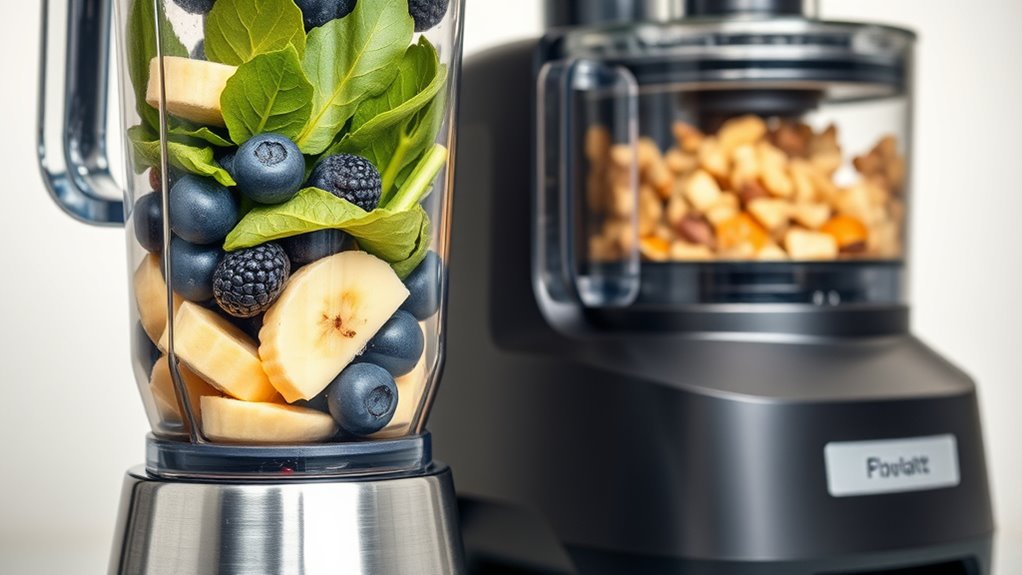

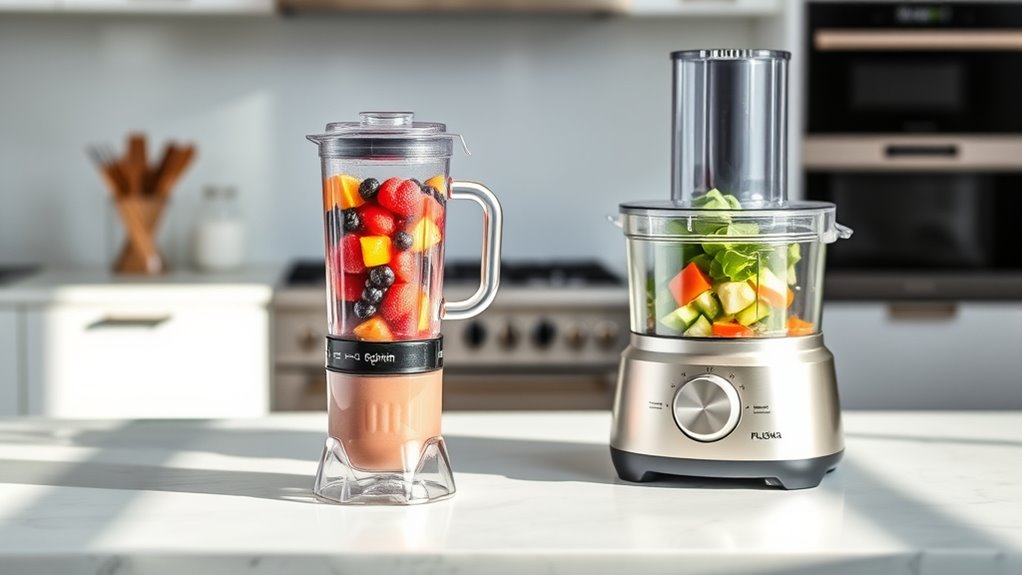
A blender is designed for smooth textures, making it perfect for blending liquids, smoothies, and icy drinks, thanks to its tall jar and sharp blades that crush ice easily. A food processor handles chopping, slicing, and mixing ingredients into chunkier textures, thanks to its wider bowl and multi-directional blades. Both appliances serve different tasks, with blenders focusing on liquids and soft foods, and food processors on more substantial prep. Exploring these differences further can help you choose the right tool for your kitchen.
Key Takeaways
- Blenders are designed for liquids and soft ingredients, producing smooth textures, while food processors handle chopping, slicing, and mixing for chunkier results.
- Blender jars are tall and narrow for liquids, whereas food processors have wider, flatter bowls suited for larger, more varied ingredients.
- Blenders have high-speed motors with multiple settings for blending, while food processors feature more robust controls for precise chopping and slicing.
- Blenders excel at crushing ice and making smoothies, whereas food processors are better for preparing dough, shredding, and heavy-duty tasks.
- Proper maintenance and safety practices, like cleaning blades and inspecting cords, are essential for both appliances’ longevity and safe operation.

Colarlemo 1800 WP Smoothie Blenders for Kitchen, 30,000 RPM Large Blender for Smoothies, Ice Crushing & Frozen Fruit Heavy Duty Grinder with 68oz BPA-Free Pitcher, Adjustment Speed Knob, Silver
Powerful Performance: This heavy duty blender delivers up to 1800W of power and 30,000 RPM for fast, consistent…
As an affiliate, we earn on qualifying purchases.
As an affiliate, we earn on qualifying purchases.
Primary Functions and Uses

A blender primarily blends liquids and soft ingredients to create smooth mixtures like smoothies, soups, and sauces. It’s perfect for making fruit smoothies, where it quickly combines fruits, liquids, and optional add-ins into a velvety drink. Blenders excel at ice crushing, allowing you to blend frozen fruits and ice cubes into icy, invigorating beverages. They’re designed for quick, high-speed processing of soft to semi-soft ingredients, producing uniform textures effortlessly. While a food processor can handle more complex chopping and slicing tasks, a blender’s main strength lies in creating smooth, consistent blends. Whether you’re blending up a quick smoothie or crushing ice for a frozen treat, a blender makes these tasks simple and efficient. Vetted

Ninja Food Processor, Professional Plus, 1000 Peak Watts, 4 Functions for Chopping, Slicing, Purees & Dough with 9-Cup Processor Bowl, 3 Blades, Food Chute & Pusher, Grey, BN601
POWERFUL PERFORMANCE: Equipped with a 1000-peak-watt motor, this Ninja food processor effortlessly handles tough ingredients, ensuring smooth and…
As an affiliate, we earn on qualifying purchases.
As an affiliate, we earn on qualifying purchases.
Design and Construction Differences
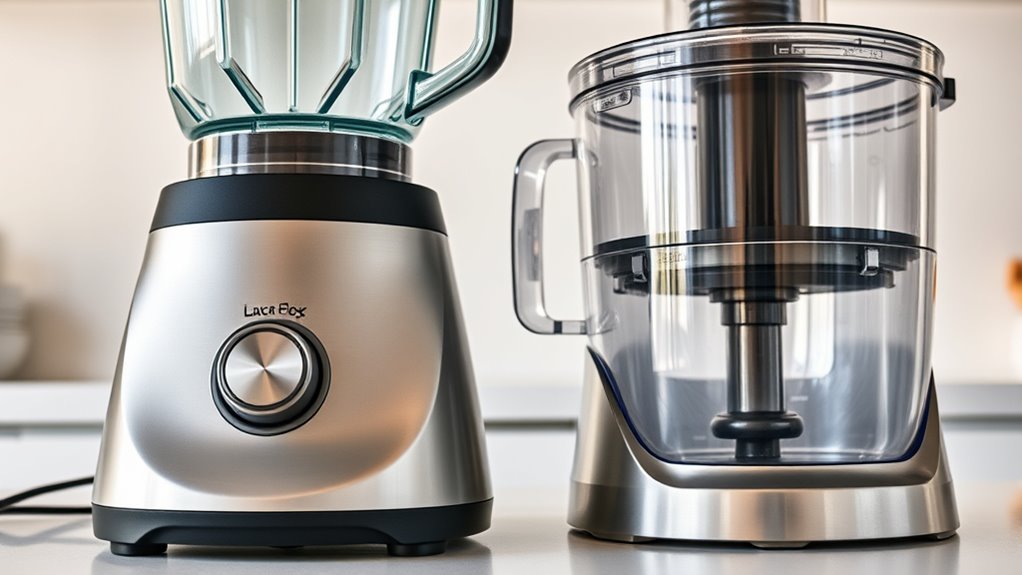
When comparing blenders and food processors, you’ll notice differences in blade design, with blenders having long, sharp blades for liquids and food processors featuring more versatile, multi-directional blades. The containers also differ, with blenders typically using tall, narrow jars made of glass or plastic, while food processors have wider, flatter bowls often crafted from durable materials. Additionally, the motor housings vary in size and structure, reflecting each appliance’s specific power needs and design focus. Some food processors are designed to handle heavy-duty tasks like chopping nuts or kneading dough, which influences their motor strength and durability. Incorporating the appropriate container shape and size is essential for optimal performance depending on the task at hand.
Blade Design Variations
Blade design variations between blenders and food processors considerably impact their efficiency and performance. Blades in blenders are typically curved and sharp to create vortexes for liquids, while food processor blades are often flat or S-shaped for chopping and slicing. The blade material influences durability; stainless steel blades are common for both, resisting rust and corrosion. Blade sharpening is essential for maintaining cutting power—blades dull over time and need regular honing. Here’s a quick comparison:
| Feature | Blender Blades | Food Processor Blades | Key Factor |
|---|---|---|---|
| Blade Shape | Curved, vortex-inducing | Flat or S-shaped | Efficiency in different tasks |
| Blade Material | Stainless steel | Stainless steel | Durability and sharpness |
| Sharpening Needs | Regular sharpening needed | Regular sharpening needed | Maintenance requirements |
| Cutting Style | Liquids and smoothies | Chopping, slicing | Task-specific design |
| Construction | Multiple blades, often fixed | Interchangeable blades | Versatility and performance |
Additionally, the ability to maintain the blades properly can significantly extend their lifespan and performance. Proper cleaning and blade sharpening techniques are crucial for optimal operation and longevity, ensuring your appliances work efficiently over time. Regular blade inspection is also recommended to identify wear and tear early, preventing performance issues.
Container Materials & Shape
Container materials and shapes considerably influence the durability, safety, and functionality of blenders and food processors. The materials used, such as glass, plastic, or stainless steel, determine how sturdy and safe your appliance is, as well as how easy it is to clean. Glass containers often look sleek and are resistant to staining, but they can be heavier and more fragile. Plastic options tend to be lighter and more impact-resistant but may scratch or stain over time. Stainless steel containers are durable and hygienic but less common for blenders. Shape and aesthetics also play a role; a wider base offers better stability, while sleek, modern designs can enhance your kitchen’s look. Choosing the right container materials and shape guarantees your appliance meets your durability, safety, and style needs. Proper installation and maintenance further ensure the longevity and safe operation of your appliance. Additionally, considering material durability helps select containers that withstand regular use without damage, especially when exposed to the powerful motors found in some models. Selecting containers made from impact-resistant materials can be especially beneficial for households with children or frequent use.
Motor Housing Structures
The design and construction of the motor housing considerably impact the overall durability and safety of blenders and food processors. A robust motor housing enhances motor protection, preventing damage from dust, moisture, and impact. It also influences noise insulation properties, reducing operational sound levels. Food processors often feature thicker, metal or reinforced plastic housings for added motor durability, while blenders typically use lighter plastic housings for portability. The construction quality directly affects longevity and user safety. Consider the following differences: | Feature | Blender Motor Housing | Food Processor Motor Housing | |—————————|———————————————-|————————————————| | Durability | Generally lighter, plastic, moderate | Thicker, metal or reinforced plastic, high | | Noise Insulation Properties | Lower, depends on housing material | Better, designed for sound dampening | | Impact Resistance | Moderate | High, for handling tougher use | | Design Focus | Portability and weight reduction | Durability and safety | Additionally, the construction quality of the housing can influence maintenance requirements and ease of repair, impacting long-term usability. Furthermore, higher-quality materials in the housing design contribute to improved overall performance and safety standards. The material selection plays a crucial role in ensuring the housing withstands daily wear and tear while maintaining safety standards. Selecting a well-engineered housing can also help in reducing vibration transfer, thereby enhancing user comfort during operation.

B- PowerExact Blender System, High-Performance Blender with Multiple Speed Settings, Powerful Motor, Durable Blades & Large Capacity Jar, Ideal for Smoothies (Black Sesame)
PrecisionSense Technology: Automatically adjusts speed and power based on ingredients for consistent blending results.
As an affiliate, we earn on qualifying purchases.
As an affiliate, we earn on qualifying purchases.
Blade Types and Their Purposes

Since different blades are designed for specific tasks, understanding their types helps you choose the right tool for your needs. Blades vary in shape, size, and function, from sharp, straight edges for slicing to curved blades for chopping. For example, a chopping blade is ideal for nuts and vegetables, while a slicing blade excels at thin, even cuts. Blade durability is essential; high-quality blades keep their sharpness longer and resist wear. Regular blade sharpening maintains cutting efficiency, preventing the need for frequent replacements. Some blades are specialized, like dough blades for mixing bread or julienne blades for spiralizing. Knowing which blade to use ensures you get the best results, whether blending smoothies or preparing ingredients for cooking. Proper blade selection also helps extend your appliance’s motor durability by reducing strain. Additionally, understanding the importance of leadership skills can enhance your ability to make informed decisions about appliance maintenance and safety. Developing an understanding of blade materials can further improve your ability to select durable, long-lasting blades that suit your specific needs. Recognizing the different blade types and their specific functions can significantly improve your efficiency and the quality of your culinary preparations. Being aware of the role of blade design can also contribute to achieving more precise and consistent results in your kitchen. Gaining knowledge about industry trends can help you stay updated on innovations that might improve your cooking experience.
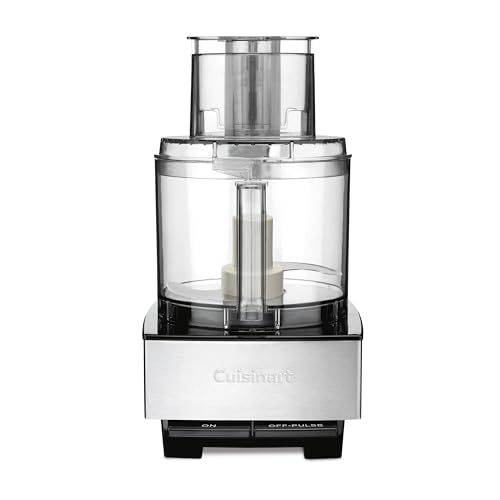
Cuisinart Food Processor, 14-Cup Vegetable Food Chopper for Mincing, Dicing, Shredding, Puree & Kneading Dough, 720-Watt Motor, Stainless Steel, DFP-14BCNY
SUPERIOR FUNCTION: The Cuisinart Food Processor with 720-watt motor functions as a vegetable chopper, blender, and food processer…
As an affiliate, we earn on qualifying purchases.
As an affiliate, we earn on qualifying purchases.
Texture and Consistency Achievements
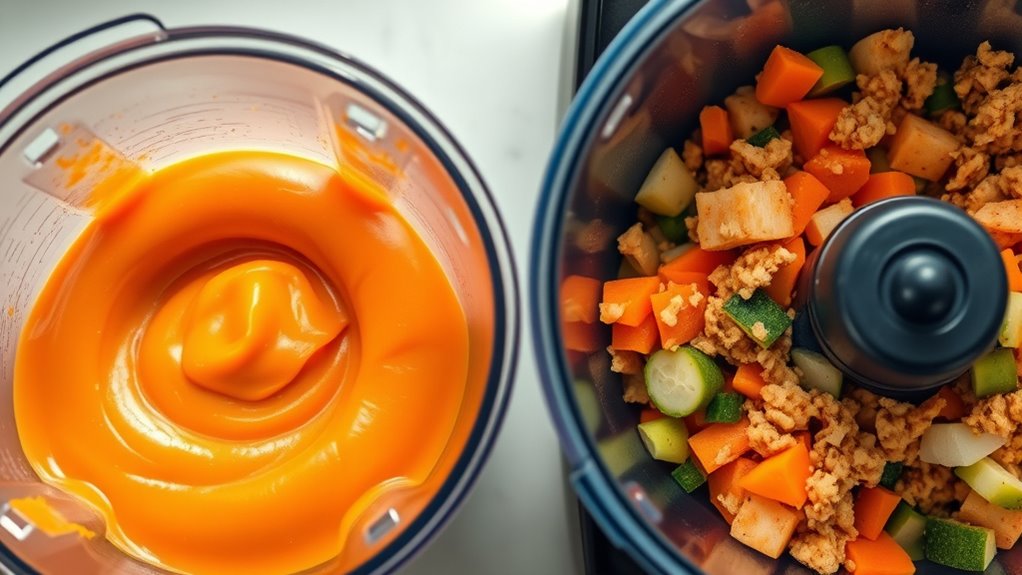
Your choice between a blender and a food processor greatly affects the texture and consistency of your results. A blender typically creates smooth, uniform mixtures, while a food processor can produce chunkier textures. Understanding these differences helps you achieve the perfect consistency for your recipes.
Smoothness and Uniformity
When it comes to achieving smooth and consistent textures, a blender generally outperforms a food processor. Blenders excel at creating silky smoothies, purees, and liquids thanks to their powerful blades and narrow jars. This results in a more uniform consistency, which can positively influence the nutritional impact by ensuring even nutrient distribution. Additionally, blenders tend to run quieter, making them more convenient for regular use without disturbing your environment.
- You’ll notice fewer lumps and more even blends with a blender.
- The smoothness helps you better appreciate the flavors and nutrients.
- Noise levels are generally lower, making your blending experience less disruptive.
Chunkiness and Texture
A food processor’s ability to handle different speeds and pulse settings gives you greater control over texture, and diverse design options can help you customize your equipment for specific culinary tasks.
Capacity and Size Variations

Capacity and size vary considerably between blenders and food processors, affecting how much you can prepare at once. A blender typically has a taller jar with a smaller overall capacity, ideal for smoothies or single servings. Food processors usually feature wider bowls that hold more ingredients, perfect for chopping or kneading large batches. Keep in mind that motor speed influences capacity; powerful motors handle bigger loads efficiently. Noise levels also differ—blenders with high motor speeds tend to be louder, especially with larger capacities. If you frequently make large quantities, opt for a food processor with a bigger bowl and quieter operation. Conversely, if you prefer quick, smaller batches, a compact blender might suit your needs better. Choose based on your typical cooking volume and noise tolerance.
Speed Settings and Control Options

Speed settings and control options vary markedly between blenders and food processors, impacting how precisely you can handle different ingredients. Blenders typically feature multiple speed control options, allowing you to adjust the blending intensity for smoothies, soups, or purees. Some models also include pulse functions for quick bursts of power. Food processors, on the other hand, often offer more advanced control options, such as digital settings that enable precise speed adjustments for chopping, slicing, or kneading. These digital settings provide consistency and ease of use, especially for complex tasks. While blenders excel with straightforward speed choices, food processors with digital controls give you greater flexibility and accuracy, making them better suited for a variety of textured preparations.
Ideal Tasks for Blenders
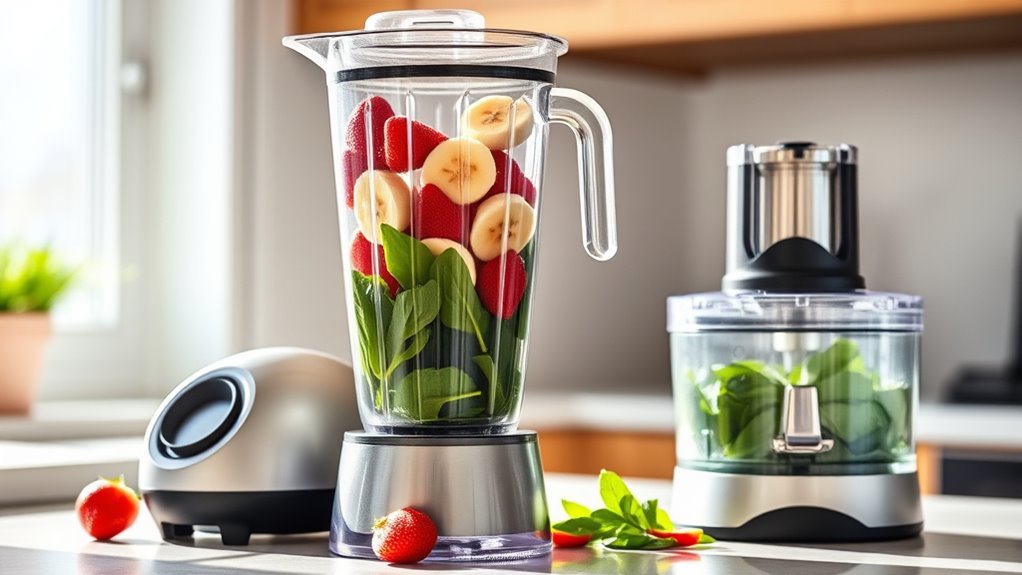
Blenders excel at tasks that require rapid liquidization and smooth textures. If you’re making smoothies, soups, or purees, a blender is your go-to tool. They’re perfect for unlocking nutritional benefits by blending fruits, vegetables, and nuts into nutrient-dense drinks and snacks. Plus, the compact design makes storage solutions simple, so you can keep your blender accessible without cluttering your kitchen.
Blenders quickly create smooth textures, nutritious drinks, and easy-to-store kitchen essentials.
Here are some ideal tasks for your blender:
- Creating smoothies and protein shakes
- Making creamy soups and sauces
- Preparing nut butters and fruit purees
Using a blender for these tasks guarantees you get consistent textures and maximize the nutritional benefits from your ingredients. It’s a quick, efficient way to enjoy healthy, delicious meals and snacks.
Ideal Tasks for Food Processors

Food processors are versatile tools designed to handle a variety of prep tasks that require chopping, slicing, shredding, and mixing. They excel at quickly transforming large quantities of vegetables, nuts, and cheeses, saving you time and effort. Their kitchen appliance versatility makes them indispensable for preparing dough, grinding spices, or making pesto and hummus. Because of their multiple functions, they help streamline meal prep, especially when working on complex recipes. To keep your kitchen organized, consider appliance storage solutions that keep your food processor accessible yet out of the way. By focusing on tasks like shredding cheese, kneading dough, or pureeing ingredients, you’ll maximize your food processor’s capabilities and enjoy more efficient cooking experiences.
Maintenance and Cleaning Considerations

When it comes to maintenance and cleaning, you’ll find that some appliances are easier to keep in top shape than others. You should consider how much effort it takes to clean each device and what maintenance tasks are involved. Making informed choices can save you time and keep your equipment functioning smoothly.
Ease of Cleaning
Cleaning either appliance is generally straightforward, but the design differences can influence how easy it is to maintain. A blender’s jar and blades are often dishwasher safe, making cleanup quick. Food processors typically have multiple parts, some of which are dishwasher compatible, but others may require hand washing. Consider if the parts are dishwasher safe for added convenience.
- Blender jars usually come apart easily and are dishwasher friendly
- Food processor bowls and blades might need some manual scrubbing
- Check if the parts are dishwasher compatible to save time
Both appliances benefit from prompt cleaning, but blenders tend to be simpler to disassemble and rinse. Dishwasher compatibility can markedly streamline maintenance, especially if you prefer dishwasher-safe components.
Maintenance Requirements
Maintaining these appliances involves different levels of effort depending on their design. A food processor typically requires more regular maintenance, such as cleaning blades and ensuring the motor base stays dry. Blenders, on the other hand, often need less frequent cleaning but may require attention to the jar seals. Both appliances benefit from proper cord storage to prevent damage, especially since power cord durability varies. For long-term use, avoid pulling or twisting cords excessively. Regularly inspect the cords for wear or cracks to ensure safety. Storing cords neatly prevents tangling and prolongs their lifespan. Overall, keeping your appliances in good shape involves simple routines like wiping down surfaces and managing cords carefully, ensuring efficient operation and longevity.
Cost and Budget Factors
The cost of a blender or food processor can vary widely, making budget considerations an important factor in your decision. To find the best value, do a thorough price comparison across different models and brands. Keep in mind that higher prices often reflect better durability, features, or brand options, but you don’t always need the most expensive. Consider your actual needs and how much you’re willing to spend.
- Look for deals or discounts on trusted brands.
- Decide if you want a basic model or one with extra features.
- Check reviews to see if the price matches the quality and performance.
Balancing cost with functionality ensures you get a device that fits your budget without sacrificing quality.
Frequently Asked Questions
Can a Blender Replace a Food Processor Entirely?
A blender can’t fully substitute a food processor, especially for gourmet smoothies and frozen desserts, but it handles many tasks well. You can blend fruits and liquids easily, but for chopping vegetables or kneading dough, a food processor is more efficient. If you’re mainly making smoothies and desserts, a high-quality blender suffices. However, for versatile cooking prep, having both tools ensures you’re prepared for all culinary needs.
Which Appliance Is Better for Making Dough?
For making dough, a food processor is better because it offers superior dough preparation and appliance versatility. You can quickly pulse ingredients without overworking the dough, ensuring a smooth, even consistency. While a blender can handle some dough, it struggles with tougher, thicker mixtures. A food processor’s powerful motor and sharp blades make it ideal for kneading and mixing, saving you time and effort during your baking process.
Are There Safety Features Specific to Each Appliance?
You’ll find safety features like safety lock features and blade guard systems in both appliances, making accidents almost impossible. These safety lock features prevent the appliance from turning on if not properly assembled, while blade guard systems shield you from sharp blades. Don’t underestimate these safety measures—they’re designed to protect you from injury, so you can focus on creating your culinary masterpiece without worry.
How Energy-Efficient Are Blenders Compared to Food Processors?
Blenders generally use less power, making them more energy-efficient than food processors. Their smaller motors consume less power during operation, which helps reduce your energy bills. Many blenders now feature eco-friendly designs, emphasizing energy savings and sustainability. If you’re looking to cut back on power consumption, a blender is a smart choice. Just guarantee you choose models with efficient motors and eco-conscious features for ideal energy efficiency.
What Accessories Are Available for Enhancing Functionality?
Think of your appliance as a Swiss Army knife—there are many accessories to unlock new skills. You can find attachments like choppers, graters, and dough hooks that boost functionality. Compatibility is key; ensure attachments fit your model. Plus, consider storage options like compact cases or drawers that keep everything organized. With the right accessories, you transform your appliance into a versatile kitchen hero, ready for any culinary challenge.
Conclusion
Choosing between a blender and a food processor depends on your cooking needs. Did you know that nearly 70% of home cooks use their blender at least three times a week? Whether you want silky smoothies or chopped vegetables, understanding their differences helps you get the right tool. With the right appliance, you’ll make meal prep faster and more enjoyable. So, pick wisely and enjoy fresh, delicious creations every day!