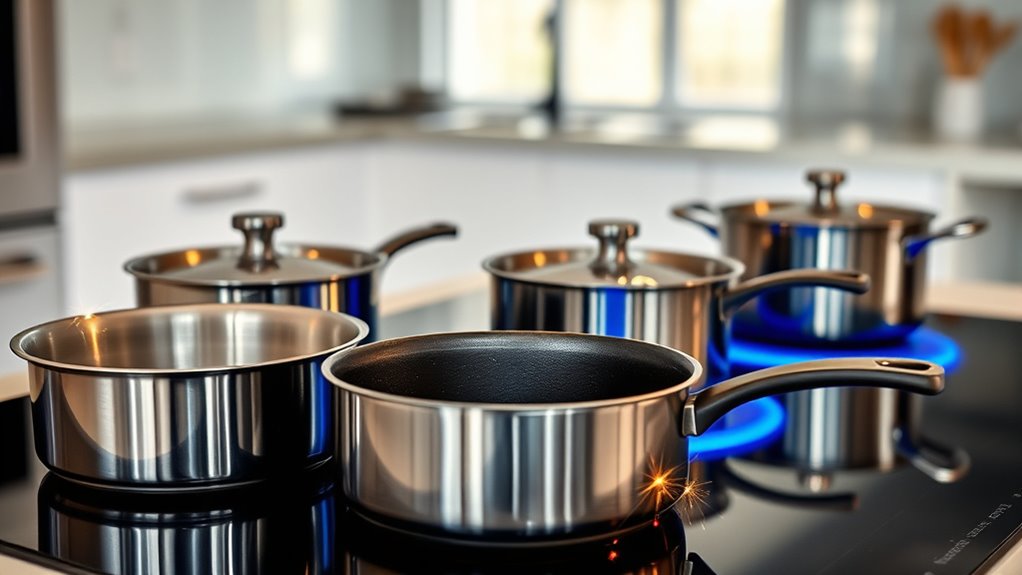

If your pots don’t heat on an induction stove, it’s likely because they aren’t made from magnet-friendly materials like cast iron or certain stainless steel. Induction cooktops use magnetic properties to generate heat, so non-magnetic materials like aluminum or glass won’t work unless a magnetic layer is added. To find out if your cookware is compatible, try sticking a magnet to the bottom—if it sticks firmly, it should work. Keep exploring to learn more about cookware compatibility.
Key Takeaways
- Induction stoves require cookware made of ferromagnetic material, like cast iron or certain stainless steel, to generate heat.
- Non-magnetic materials such as aluminum, copper, and glass won’t work unless they have a magnetic layer added.
- A simple magnet test can determine if your pots are compatible; if the magnet sticks firmly, they should work.
- Some cookware includes a magnetic stainless steel disc at the bottom to enable induction compatibility.
- Without magnetic properties, cookware cannot activate the induction stove’s heat generation, leading to incompatibility.
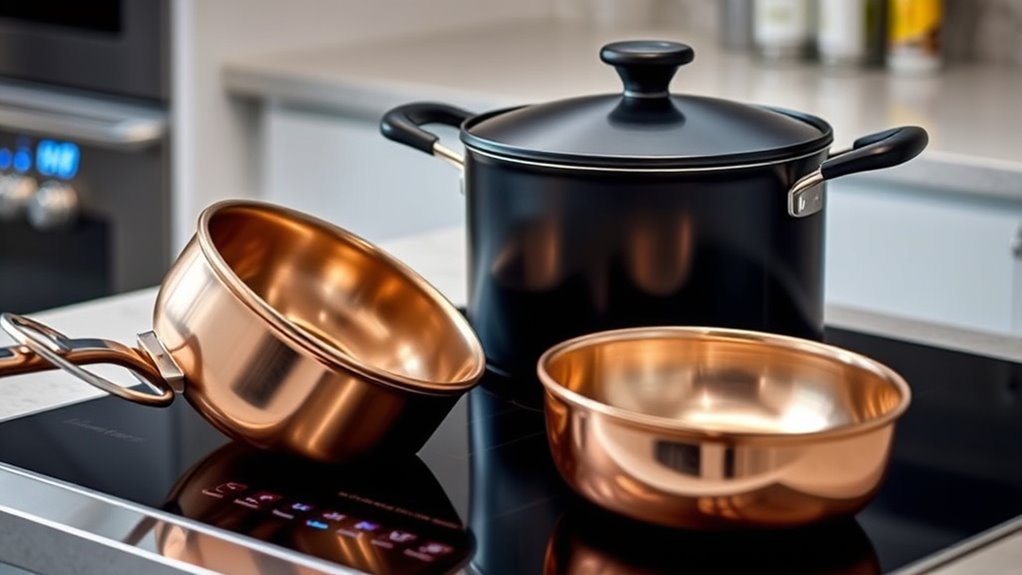
The secret lies in the cookware material. Induction-compatible pots are typically made from ferromagnetic metals—materials that can be magnetized easily. Cast iron and some stainless steel varieties are excellent choices because they contain magnetic properties. On the other hand, cookware made from aluminum, copper, glass, or non-magnetic stainless steel won’t work unless it has a magnetic layer added to its base. Manufacturers often add a magnetic stainless steel disc to the bottom of non-compatible pots to make them induction-ready, but not all cookware has this feature. So, if you’re unsure whether your existing pots will work, a simple magnet test can help. If a magnet sticks firmly to the bottom, it’s likely compatible with your induction stove. Magnetic properties are crucial for ensuring your cookware will heat effectively on induction surfaces. The importance of cookware material extends beyond mere compatibility. It influences heat distribution, durability, and overall cooking performance. For example, cast iron heats evenly and retains heat well, making it ideal for induction cooking. Stainless steel with a magnetic base offers a good balance of durability and efficiency, but if it lacks magnetic properties, it won’t work on an induction stove regardless of its quality. Conversely, cookware made from non-magnetic materials may be cheaper or lighter but won’t activate your induction hob unless specifically designed for it. This is why choosing the right cookware material is critical if you want to maximize the benefits of induction cooking.
Frequently Asked Questions
Can Non-Metallic Pots Be Used on Induction Stoves?
No, non-metallic cookware can’t be used on induction stoves due to induction limitations. Induction cooking relies on magnetic fields to generate heat, so your pots need to be ferromagnetic. Non-metallic cookware, like glass or ceramic, won’t respond to these magnetic fields. If you’re set on using non-metallic options, you’ll need to get a compatible induction interface disk that converts non-metallic cookware into suitable cookware for induction cooking.
Do All Stainless Steel Pots Work With Induction Cooktops?
You might think all stainless steel pots work with induction cooktops, but that’s not always the case. Not all stainless steel cookware has the right magnetic compatibility to work on induction stoves. To be sure, check if a magnet sticks to the bottom—if it does, your stainless steel pot should work. Remember, the cookware material and its magnetic properties are the key to compatibility, so don’t assume all stainless steel is a perfect fit.
How Can I Tell if My Cookware Is Induction-Compatible?
To tell if your cookware is induction-compatible, perform a magnetic test by placing a magnet on the bottom. If it sticks firmly, your pot is suitable for induction cooking. Also, check for cookware labels or symbols indicating induction compatibility. This quick method helps you identify whether your pots and pans will work effectively, ensuring you don’t waste time or money on incompatible cookware.
Why Does Some Cookware Spark or Make Noise on Induction Stoves?
Like a guitar string vibrating, cookware noise on induction stoves often results from poor magnetic compatibility. When your pot isn’t fully compatible, it can cause sparking or a humming sound due to uneven contact with the induction cooktop’s electromagnetic field. This noise indicates electrical arcing or magnetic interference, which may harm your stove or cookware. To avoid this, verify your cookware is induction-compatible and has a flat, smooth base.
Are There Any Safety Concerns With Induction Cookware?
You don’t need to worry much about safety concerns with induction cookware. It’s designed with safety in mind, reducing fire hazards because it only heats when directly in contact with the induction surface. Plus, it minimizes electrical safety risks since the stove itself doesn’t get hot, decreasing accidental burns or fires. Just verify your cookware is compatible, and you’ll enjoy safe, efficient cooking without added worries.
Conclusion
Did you know that over 50% of households now use induction stoves? That’s a huge shift in cooking technology! But remember, not all pots work on induction, so always check if your cookware is compatible before cooking. Using the right pots not only makes your meals faster and more efficient but also prevents damage to your stove. Make sure your cookware is induction-ready, and you’ll enjoy seamless, modern cooking every time.