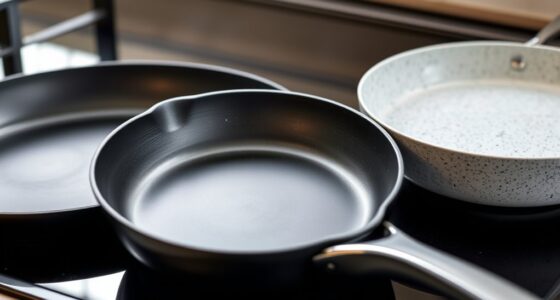
Pans with copper bottoms are designed to provide rapid, even heat transfer, helping you cook more precisely. Copper’s excellent thermal conductivity means it responds quickly to temperature changes, reducing hot spots and ensuring consistent results. This enhances control and prevents burning or uneven cooking. If you want to understand how copper’s unique properties improve your cooking and why they matter, keep exploring what makes copper cookware so effective.
Key Takeaways
- Copper bottoms enhance heat conduction, ensuring rapid and even heat transfer across the pan surface.
- Copper’s high thermal conductivity prevents hot spots, promoting uniform cooking.
- Copper bottoms respond quickly to stove temperature adjustments, allowing precise control.
- They improve energy efficiency by reducing the time and energy needed to reach desired heat.
- Copper is durable and maintains its thermal properties with proper maintenance, ensuring consistent performance.

Pans with copper bottoms are a popular choice for both professional chefs and home cooks because they offer superior heat conduction and even cooking. The reason behind this lies in the unique copper alloy properties that make copper an exceptional material for cookware. Copper has a high heat conduction efficiency, meaning it can transfer heat quickly and evenly across its surface. This minimizes hot spots and guarantees your food cooks uniformly, whether you’re simmering sauces or searing steaks. When you use a pan with a copper bottom, you’re leveraging the metal’s natural ability to respond rapidly to temperature changes, giving you precise control over your cooking process.
Pans with copper bottoms ensure even cooking thanks to copper’s high heat conduction and rapid temperature response.
The copper alloy properties contribute considerably to its popularity in cookware manufacturing. Copper’s high thermal conductivity allows it to react swiftly to adjustments on the stove, unlike materials like stainless steel or cast iron, which take longer to heat up or cool down. This responsiveness is especially important for delicate tasks such as melting chocolate or cooking sauces where temperature consistency is vital. The alloy composition often includes other metals like tin or zinc, which enhance durability and ease of maintenance without compromising heat conduction efficiency. These properties give copper pans a combination of strength and flexibility, making them reliable tools in your kitchen.
You’ll notice that the even heat distribution provided by copper helps prevent burning or uneven cooking. When heat is distributed uniformly, your ingredients cook at the same rate, reducing the risk of overcooking or undercooking certain areas. This property is particularly advantageous when preparing complex dishes that require meticulous temperature control. Additionally, the rapid response to temperature adjustments means you can turn down the heat quickly if your sauce starts to simmer too vigorously or increase it to sear meats properly. This level of control is what makes copper-bottom pans highly valued by serious cooks.
Furthermore, the heat conduction efficiency of copper isn’t just about performance; it also impacts energy usage. Because copper heats up quickly and distributes that heat evenly, you often need less energy to achieve the desired temperature. This efficiency can save you money over time and improve your overall cooking experience. Plus, with proper care, copper cookware can last for many years, maintaining its excellent thermal properties. In sum, understanding the copper alloy properties and their influence on heat conduction efficiency helps you appreciate why pans with copper bottoms are a top choice for those who prioritize precision and quality in their cooking. Proper care and maintenance of copper cookware ensure it continues to perform at its best, preserving the qualities that make it a favorite among chefs.
Top picks for "some pans copper"
Open Amazon search results for this keyword.
As an affiliate, we earn on qualifying purchases.
Frequently Asked Questions
Are Copper-Bottom Pans Safe for All Types of Stovetops?
Copper-bottom pans are generally safe for most stovetop types, but you should check their stovetop compatibility first. For example, they work well on gas and electric stoves, offering excellent heat transfer efficiency. However, if you have an induction stove, confirm the pan has a magnetic base, as copper alone isn’t magnetic. Always verify manufacturer instructions to avoid damage and ensure safe, efficient cooking.
How Do Copper Bottoms Affect Cookware Durability Over Time?
Copper bottoms can enhance cookware durability, but they’re susceptible to metallic corrosion over time, especially if not cared for properly. With thermal expansion, copper may loosen or warp after repeated heating and cooling cycles. Notably, studies show copper’s excellent heat conduction extends cookware lifespan when maintained correctly. To keep your pans in top shape, avoid harsh abrasives, and regularly inspect for signs of corrosion or warping, ensuring long-lasting performance.
Can You Use Copper-Bottom Pans in the Oven?
Yes, you can use copper-bottom pans in the oven, but check the manufacturer’s guidelines first. Copper handles may not be oven-safe, so confirm they’re oven-safe or remove them. Copper bottoms improve heat transfer efficiency, making your cooking more even. For oven safety, verify that the pan’s materials can withstand high temperatures without damage. Properly used, copper-bottom pans can handle oven conditions and deliver excellent heat distribution.
Are Copper-Bottom Pans Suitable for Induction Cooktops?
Copper-bottom pans aren’t suitable for induction cooktops because they lack the necessary magnetic properties for induction compatibility. Imagine a magnet trying to cling to a shiny copper surface—it simply won’t stick. For effective induction cooking, your pan must have ferromagnetic qualities. While copper excels at heat conduction, it doesn’t respond to magnetic fields, so using a copper-bottom pan directly on an induction stove won’t work unless it has a magnetic stainless-steel layer.
How Do I Clean and Maintain Copper-Bottom Cookware?
To clean and maintain your copper-bottom cookware, start by polishing it regularly with gentle polishing techniques to keep its shine. Use specialized cleaning agents designed for copper, avoiding harsh abrasives that can scratch the surface. For stubborn stains, create a paste with lemon juice and salt, then gently scrub. Rinse thoroughly and dry immediately to prevent water spots. Proper care guarantees your cookware remains beautiful and functional for years.
Conclusion
You now see why copper-bottom pans are a great choice—they heat evenly, preventing hot spots. Did you know that copper conducts heat about 25 times better than stainless steel? This efficiency means your food cooks more consistently, saving you time and effort. So, next time you cook, consider a copper-bottom pan for perfect results every time. The science behind it guarantees your meals are evenly cooked, making your culinary experience better and more enjoyable.