
TL;DR

Get kitchen staples and gadgets delivered free with Prime
- Fast, free delivery on millions of items
- Prime Video, Amazon Music and more included
- Member-only deals all year
Researchers from the University of Reading and the Animal and Plant Health Agency tested violet-blue photodynamic inactivation against 64 Campylobacter strains. The study report says every strain was killed, including strains with different antibiotic resistance profiles, but more trials are needed to assess the technique’s promise for chicken.
Researchers from the University of Reading and the Animal and Plant Health Agency report that a non-contact violet-blue light treatment killed all 64 Campylobacter strains tested, including strains with different antibiotic resistance profiles. The findings suggest a possible way to reduce the foodborne bacteria on chicken without adding chemicals, but the researchers say more trials are needed before its practical effectiveness can be established.
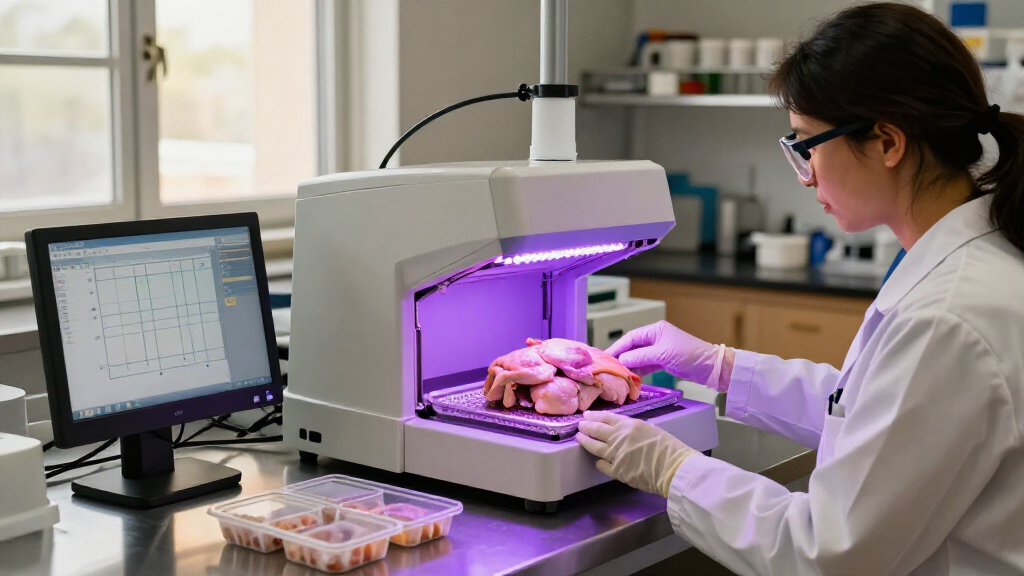
The technique, called violet-blue photodynamic inactivation (VB-PDI), uses light to target bacteria. The study tested it against 64 strains of Campylobacter. According to the findings reported by Food Safety News, every strain was killed, regardless of species or antibiotic resistance profile.
The approach does not require physical contact with the food or the addition of chemicals, the report said. Those features make it a potential treatment to investigate for chicken processing, but the reported result is from testing the strains; it does not establish how the method performs on chicken under commercial conditions.
The findings were reported on October 9, 2026. The available report does not provide the treatment’s light dose, exposure time, test conditions, or quantitative reduction in bacteria. It also does not describe tests of food quality, production-line performance, or whether the effect lasts during storage.
Reducing Risk From Raw Chicken
Campylobacter is identified in the report as the most common cause of bacterial gastroenteritis worldwide. It is also a public health concern in the UK: the report cites 70,000 laboratory-confirmed cases in 2024 and 2025. The figures are presented together, and the source does not break them down by year.
Chicken is relevant because the bacteria are killed by thorough cooking, but handling raw meat can spread contamination to hands, utensils, surfaces, or food that will not be cooked. A treatment that reduces Campylobacter on chicken could offer another point of control, if further testing shows it works reliably and can be used safely in food production.
At this stage, the result is a promising laboratory finding, not evidence that the technique has reduced infections or is ready for use in shops or processing plants. Consumers should continue to follow ordinary food-safety practices, including keeping raw chicken separate from ready-to-eat foods and washing hands and utensils after handling it.
As an affiliate, we earn on qualifying purchases.
What the Strain Tests Show
The study tested 64 Campylobacter strains, rather than reporting a trial across commercial chicken production. The source says the strains represented different species and antibiotic resistance profiles, and that all were killed by VB-PDI. It does not identify the individual strains or describe the laboratory protocol in detail.
That distinction matters when interpreting the result. A finding across a set of bacterial strains can show that the treatment warrants further investigation, but it does not by itself show that it can remove contamination from the varied surfaces and conditions found in food processing. The report itself characterizes blue light as a promising option and says further trials are needed.
“The use of blue light to reduce Campylobacter on chicken is a promising option but more trials are needed.”
— Food Safety News, reporting the study findings
As an affiliate, we earn on qualifying purchases.
Key Questions Before Food Use
The report does not state whether VB-PDI has been tested on chicken itself, as opposed to bacterial strains, or how much bacteria it reduced under the test conditions. The treatment’s required exposure time and light intensity are also not given in the available material.
It remains unclear whether the technique would work consistently on chicken with different surfaces, contamination levels, or processing conditions. The source also does not report possible effects on food quality or storage, nor any assessment of cost, equipment, or fit with existing production lines. No evidence is provided that using the method has reduced human illness.
campylobacter bacteria reduction light
As an affiliate, we earn on qualifying purchases.
As an affiliate, we earn on qualifying purchases.
Further Trials Needed on Chicken
The next step identified in the report is additional trials. Testing on chicken and under conditions closer to food processing would help show whether the effect seen across the 64 strains translates to a practical reduction in contamination.
No timetable, trial plan, or regulatory decision is included in the source material. Until more evidence is reported, VB-PDI should be treated as an approach under investigation rather than a replacement for established cooking and raw-meat handling precautions.
food processing UV light treatment
As an affiliate, we earn on qualifying purchases.
As an affiliate, we earn on qualifying purchases.
Key Questions
What is violet-blue photodynamic inactivation?
VB-PDI is a light-based technique tested against Campylobacter. The report says it does not require physical contact with food or added chemicals, but it does not provide technical details about the light treatment.
How many Campylobacter strains were tested?
The researchers tested 64 strains. The report says the treatment killed all of them, across different species and antibiotic resistance profiles.
Does the study show that blue light is ready to treat chicken commercially?
No. The findings suggest potential, but the report says more trials are needed. It does not establish performance on chicken in commercial processing conditions.
How can people reduce Campylobacter risk from chicken now?
Cook chicken thoroughly and prevent raw meat or its juices from contaminating ready-to-eat food. Wash hands and clean utensils and surfaces after handling raw chicken.
Source: rss
Halloween Picks
halloween
As an affiliate, we earn on qualifying purchases.