
TL;DR

Get kitchen staples and gadgets delivered free with Prime
- Fast, free delivery on millions of items
- Prime Video, Amazon Music and more included
- Member-only deals all year
A Good Housekeeping Institute Lab test found frozen ground beef on a metal baking sheet thawed 90 minutes faster than on a ceramic plate. However, both counter-thawing methods violated USDA food-safety guidance, with meat sitting at room temperature for over three hours above 40°F.
A hands-on test by the Good Housekeeping Institute Kitchen & Cooking Lab found that frozen ground beef placed on an uncoated metal baking sheet thawed 90 minutes faster than identical beef on a ceramic plate — but the tester concluded he would never use the method again because both versions violated USDA food-safety rules on counter thawing.
Mark Marino, a contributing analyst and writer in the Lab, tested the widely shared online hack that claims a metal sheet speeds up defrosting. He placed 1 pound of frozen ground beef on an uncoated metal baking sheet and another pound on a ceramic dinner plate, both on a countertop in the Lab on a 73°F day. He checked surface temperatures on both sides of each package every 30 minutes with an infrared thermometer and considered the meat thawed when a meat thermometer probe slid easily into its center.
The beef on the metal sheet was fully thawed at the three-hour mark, with a center temperature of 31°F, while its surface measured 44.6°F on top and 53.6°F on the bottom. The beef on the ceramic plate did not thaw until four and a half hours had passed. At the 30-minute mark, the ice coating under the meat on the metal sheet had already melted and the meat was softening, while the plate sample remained quite frozen.
However, Marino reported that neither method is considered safe under food-safety rules. The tester wrote that he would not do it again, and the report’s bottom line states that counter thawing “isn’t considered safe and can promote harmful bacterial growth.”
Why Counter Thawing Fails Safety Rules
The test matters because the metal-sheet hack circulates widely online as a convenient shortcut, and the results show it does deliver on speed — the aluminum’s heat conduction is real. But speed is not the same as safety. According to the USDA, perishable food should not be thawed on the counter or left at room temperature for more than two hours, because bacteria can multiply rapidly in the “danger zone” between 40°F and 140°F.
In the test, both packages of meat sat on the counter for a minimum of three hours and were above 40°F when they finished thawing — the metal-sheet beef’s bottom surface reached 53.6°F. That means the faster method, by pulling heat into the meat more quickly, also pushes it into the bacterial danger zone sooner. For home cooks deciding whether to try the hack, the report’s answer is that the time saved is not worth the food-safety risk.
How the Test Was Run
The metal-sheet method is based on the fact that metals like aluminum conduct heat well: the theory is that the baking sheet absorbs a room’s natural heat and transfers it into the food faster than ceramic or plastic. The Good Housekeeping Institute Kitchen & Cooking Lab regularly tests meal-prep methods and products; Marino, a writer, food editor and product tester with more than seven years in digital food media, has also tested single-serve coffee makers for the Institute.
Baseline measurements at the start: the surface temperature on top of both frozen packages measured 2.5°F, while the bottom of the beef on the baking sheet measured 10.1°F versus 3.9°F for the beef on the plate. At two hours, the metal-sheet beef had softer edges and released more juice when turned; the plate beef was still firm.
“Defrosting meat on metal is definitely faster than using a ceramic plate, but thawing meat on the counter isn’t considered safe and can promote harmful bacterial growth. Use the refrigerator, cold water, or the microwave instead.”
— Mark Marino, Good Housekeeping Institute Kitchen & Cooking Lab
Limits of a Single-Kitchen Test
The findings come from one test session with one cut of meat (ground beef), one room temperature (73°F), and one type of uncoated metal sheet, so results could vary with different meats, thicknesses, pan materials, or kitchen conditions. The report does not claim the tested meat was unsafe to eat or that illness resulted — only that the method falls outside USDA-recommended practice. It is not clear from the report how the hack performs with larger roasts, poultry, or frozen-solid steaks.
Safer Ways to Thaw Fast
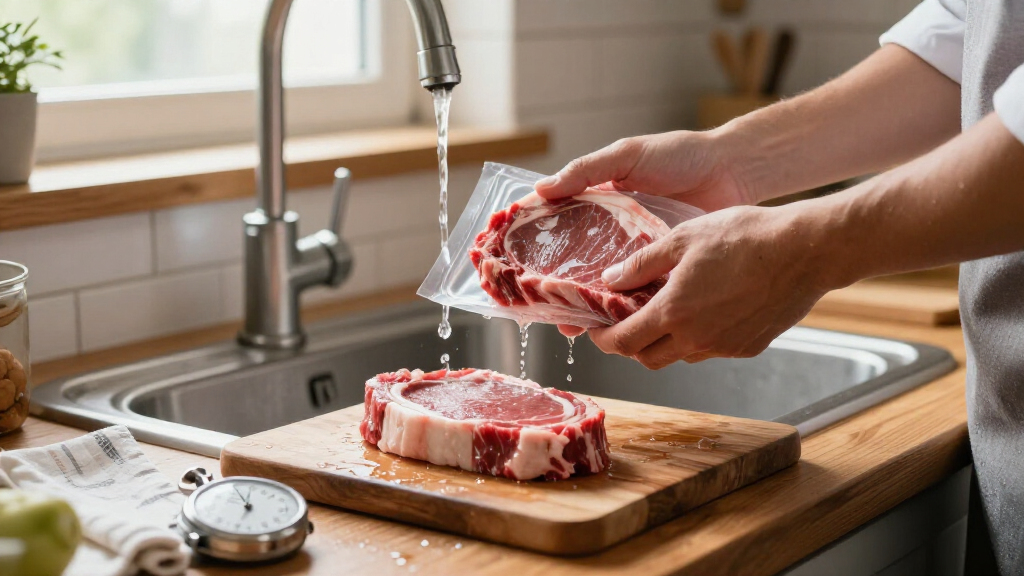
The report recommends three USDA-aligned alternatives. Use the microwave, following the manufacturer’s defrost instructions and cooking the meat immediately after thawing. Use the cold-water method: seal the meat in a zip-top bag, submerge it in cold water, change the water every 30 minutes, and cook as soon as it thaws. Or plan ahead and thaw meat in the refrigerator, where it stays at a safe, constant temperature. The Institute’s broader testing of kitchen shortcuts and appliances continues.
Key Questions
Does meat actually thaw faster on a metal baking sheet?
Yes. In the Good Housekeeping test, 1 pound of frozen ground beef on an aluminum sheet thawed in three hours, while the same amount on a ceramic plate took four and a half hours — a 90-minute difference.
Why is thawing meat on the counter unsafe?
According to the USDA, bacteria multiply rapidly between 40°F and 140°F, and perishable food should not sit at room temperature more than two hours. In the test, both samples sat out three or more hours and finished above 40°F.
What is the fastest safe way to defrost meat?
The microwave is the fastest USDA-accepted option, but the meat must be cooked immediately after thawing. Cold-water submersion, with water changed every 30 minutes, is another quick method.
Is refrigerator thawing the safest option?
Yes. The refrigerator keeps meat at a safe, constant temperature throughout thawing, though it requires planning ahead — typically a day or more depending on the size of the cut.
Did the tested meat become unsafe to eat?
The report does not state the meat caused illness, only that both counter methods exceeded USDA time and temperature guidance, which the report says can promote harmful bacterial growth.
Source: rss
Fall Picks
fall essentials
As an affiliate, we earn on qualifying purchases.