
TL;DR

Get kitchen staples and gadgets delivered free with Prime
- Fast, free delivery on millions of items
- Prime Video, Amazon Music and more included
- Member-only deals all year
A writer at Casual Physics Enjoyer reported that soaking thin raw chicken in a tartrazine solution produced slight translucency, with a grid visible through part of the sample. The home experiment did not reproduce the stronger transparency reported in a scientific paper, and the chicken was discarded rather than eaten.
A home experiment reported by Casual Physics Enjoyer found that thin pieces of raw chicken soaked in tartrazine, a yellow food dye associated with Doritos, became slightly translucent. The result was limited: a grid could be seen through part of a roughly 2-millimeter slice, but the chicken did not become fully transparent, and the sample was discarded.
The writer said the trial was inspired by a scientific paper, “Achieving optical transparency in live animals with absorbing molecules,” by Ou and co-authors. That paper describes using tartrazine to make biological tissues, including chicken breast, more transparent. The home test was an altered, preliminary replication rather than a full reproduction of the published protocol.
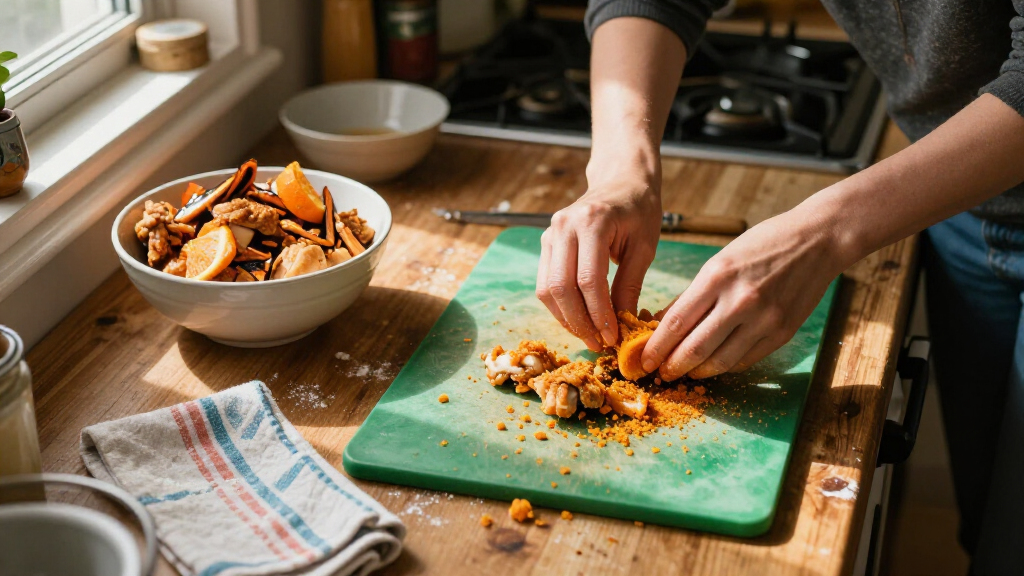
For the main reported sample, the writer soaked chicken in an approximately 0.19-molar tartrazine solution at room temperature. One trial lasted six hours; a later trial lasted 12 hours. The writer described the treated chicken as having a gelatinous or gummy-bear-like appearance and said a grid was faintly visible through a thin slice. A water-soaked control remained opaque.
A more concentrated solution, estimated at about 0.56 molar, did not produce a usable result: the writer said the dye appeared to crystallize on the chicken. The dye powder was listed as more than 80% tartrazine, leaving uncertainty about the precise concentration. The report says the pieces were thrown away; it does not describe them as food.
A Low-Cost Test of Tissue Imaging
The experiment is a small-scale demonstration of a technique that could matter for optical imaging. In the paper cited by the writer, tartrazine treatment is used to improve visibility through biological tissue, a potential aid for imaging structures that are otherwise difficult to see. The home trial suggests that some visual change can be observed with basic materials, but it does not establish that the approach will work reliably outside controlled research settings.
The writer said the longer-term interest is whether tissue transparency could help independent researchers observe internal structures with relatively accessible equipment. That remains a possibility, not a result demonstrated by this trial. The reported sample was only partly translucent, and the post supplies no quantitative measurement of transparency or comparison across repeated trials.
The distinction matters because a visually striking demonstration is not the same as a validated imaging method. The experiment offers an informal observation that may motivate further testing; it does not show that home-prepared tartrazine solutions can safely or consistently reproduce the effects described in the scientific paper.
food dye tartrazine for culinary experiments
As an affiliate, we earn on qualifying purchases.
As an affiliate, we earn on qualifying purchases.
The Published Method and Home Trial
The source report says the paper’s protocol used a 0.62-molar solution, a temperature of 40 degrees Celsius and a machine shaker. The writer did not use those conditions, citing a lack of equipment and concerns about carrying out the procedure safely. Instead, the chicken was soaked at room temperature in a weaker solution.
The writer’s proposed explanation is that tartrazine’s absorption properties may change water’s refractive index, bringing it closer to that of proteins and lipids in tissue and reducing light scattering. The post presents this as a current model, with a fuller explanation promised later; it is not a mechanism established by the home test itself.
The food-safety context is also distinct from the dye’s use as a food color. The report notes that the chicken was raw and left at room temperature during the soak. It was discarded, not eaten. Raw poultry can carry pathogens such as Salmonella, so the experiment should not be treated as a cooking or food-preparation method.
“I got partial transparency but not to the degree of the paper.”
— Casual Physics Enjoyer
As an affiliate, we earn on qualifying purchases.
Limits of the Transparency Result
The report does not give a measured transparency value, independent replication, or enough repeated trials to establish how consistent the effect is. The visible grid was reported through only part of a thin slice, and the writer noted that the result was difficult to see in the camera image.
The exact dye concentration is also uncertain because the powder was specified as more than 80% dye, while the solution calculations used its nominal mass. The writer said actual concentrations could be up to about 15% lower. It is also not clear whether the result would change under the paper’s warmer, agitated conditions, or whether the crystallization seen in the more concentrated solution could be avoided.
The post does not report peer review or external verification of this home experiment. Its result should be read as an informal observation, not evidence that the method is ready for routine use or safe for food.
food coloring for transparency experiments
As an affiliate, we earn on qualifying purchases.
As an affiliate, we earn on qualifying purchases.
Further Testing Is Planned
The writer said a more ambitious replication is planned, but did not provide a date, a finalized method, or details of the next experiment. The post also said a more detailed explanation of the proposed optical mechanism would follow.
Any follow-up would need to clarify the solution concentration, temperature, exposure time and imaging method, and distinguish visible appearance from measured optical performance. Until those details are available, the current finding remains a limited demonstration: slight translucency in a thin raw chicken sample, with no evidence that the sample was fully transparent.
As an affiliate, we earn on qualifying purchases.
Key Questions
What does “making chicken transparent” mean in this report?
It refers to a reported change in how light passed through a thin piece of raw chicken after soaking. The writer saw a grid through part of a roughly 2-millimeter slice, but described the result as partial translucency, not full transparency.
What is Dorito dust in this experiment?
The phrase refers to tartrazine, a yellow-orange food dye that the report says is found in Doritos. The experiment used tartrazine powder dissolved in water; it did not use crushed chips as the active ingredient.
Did the home experiment reproduce the scientific paper?
No. The writer used a weaker solution at room temperature and lacked the 40-degree-Celsius setup and machine shaker described in the paper. The writer said the home result fell short of the paper’s effect.
Is the treated chicken safe to eat?
The report does not present the sample as food and says the chicken pieces were discarded. Raw poultry can carry Salmonella and other pathogens; this experiment is not a safe food-preparation method.
What remains to be tested?
The result needs repeated trials and objective measurements to establish how much translucency occurs and whether it can be reproduced. The writer says a more ambitious replication is planned, but has not provided its timing or protocol.
Source: hn
Halloween Picks
halloween
As an affiliate, we earn on qualifying purchases.