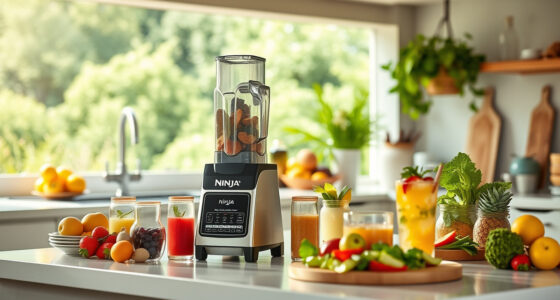
A blender can handle many tasks like making smoothies, crushing ice, and frothing milk, but it can’t fully replace a food processor. Blenders excel at blending liquids and purees but lack blades and attachments for chopping, slicing, or shredding solid foods. If you need precise cuts or dough kneading, a food processor is better suited. To discover more about when and how each appliance is useful, keep exploring.

Get kitchen staples and gadgets delivered free with Prime
- Fast, free delivery on millions of items
- Prime Video, Amazon Music and more included
- Member-only deals all year
Key Takeaways
- Blenders excel at pureeing, blending, and crushing ice but are limited in chopping, shredding, and slicing tasks.
- High-powered blenders can froth milk and handle some cold beverage prep, but not precise food processing.
- Food processors are better suited for tasks requiring uniform chopping, slicing, shredding, and kneading dough.
- A blender can substitute for a food processor in specific tasks like smoothies and ice crushing but not for comprehensive food prep.
- For diverse kitchen tasks, investing in a dedicated food processor is recommended over relying solely on a blender.

Have you ever wondered if a blender can truly take the place of a food processor? While both appliances are versatile kitchen tools, they serve different primary functions. A blender excels at creating smooth, uniform textures, making it perfect for smoothies, soups, and drinks. However, when it comes to tasks like milk frothing or ice crushing, a blender can be surprisingly effective, though not always as specialized as a food processor. If you’re considering whether your blender can handle your prep work, it’s worth understanding what it does well and where it might fall short.
Milk frothing is one area where a high-powered blender can shine. With the right settings, it can whip up creamy, frothy milk for your coffee drinks or cappuccinos. Some blenders even have dedicated milk frothing functions, making it easy to get that perfect foam without a separate frother. When it comes to ice crushing, blenders are often quite capable. Their strong motors and sharp blades can break down ice cubes into crushed ice for cocktails, smoothies, or slushies. This makes a blender a handy tool for cold beverage prep, especially if it’s a model designed with sturdy blades and high wattage.
However, while your blender might handle milk frothing and ice crushing well, it’s important to recognize its limitations. Unlike a food processor, which features different blades and attachments for chopping, slicing, and shredding, a blender’s design is optimized for liquids and purees. It won’t perform well on tasks such as kneading dough, shredding cheese, or chopping vegetables into uniform pieces. For those tasks, a food processor’s versatility is unmatched because of its variety of blades and bowls.
That said, if your main needs involve making smoothies, crushing ice, or whipping up frothy drinks, your blender can serve as a decent substitute for a food processor. Just keep in mind that it won’t replace specialized tasks that require precise chopping or mixing functions. In many cases, a good blender can handle a surprising range of tasks, especially if it’s a high-quality model built for power. But for more diverse food prep, investing in a dedicated food processor might still be the better choice. So, while your blender can step in for some tasks, understanding its strengths and limitations will help you decide when it’s the right tool for the job.
high power blender for smoothies
As an affiliate, we earn on qualifying purchases.
As an affiliate, we earn on qualifying purchases.
Frequently Asked Questions
Can Blenders Handle Dough Kneading Effectively?
Blenders aren’t designed for dough kneading or gluten development, so they won’t handle that task effectively. The powerful, stationary blades can’t mimic the consistent, gentle kneading needed for proper dough texture. If you try to use a blender for dough, you risk overworking the ingredients or damaging the appliance. For proper gluten development and smooth dough, it’s best to stick with a food processor or traditional kneading methods.
What’s the Difference in Blade Design Between Blenders and Food Processors?
Think of blender blades as delicate dancers, spinning swiftly for smoothies, while food processor blades are rugged workhorses, built for tough tasks. Blender blades are usually curved for blending and pureeing, focusing on liquid finesse, whereas food processors have multiple blades—flat discs, S-shaped, or chopping blades—designed for chopping, slicing, and dough. The difference lies in blade versatility and motor power, making each tool uniquely suited for specific kitchen battles.
Are There Specific Blender Models That Perform Better as Food Processor Substitutes?
Some blenders, especially high-powered models like Vitamix or Blendtec, can serve as alternative uses for food processing tasks such as chopping, pureeing, and making dough. These models often come with versatile blades and variable speeds. While they may cost more upfront, they can replace a food processor for many tasks, making them a cost comparison worth considering. However, for heavy-duty processing, a dedicated food processor remains more efficient.
How Do Cleaning and Maintenance Compare Between Blenders and Food Processors?
You’ll find cleaning and maintenance easier with a blender, as its smooth interior simplifies kitchen safety and prevents residue buildup. Blenders usually have fewer parts, making cord storage straightforward and reducing clutter. Food processors, with their multiple attachments, require more thorough cleaning and careful handling to avoid damage. Regularly check for wear and tear to guarantee safety. Both appliances benefit from proper maintenance, but blenders generally offer quicker, simpler upkeep.
Can Blenders Efficiently Chop Nuts and Hard Vegetables?
A blender isn’t your best bet for chopping nuts and hard vegetables; it’s more like a tornado swirling ingredients into a smoothie consistency. While it’s great for ice crushing and blending soft items, it struggles with evenly chopping tough nuts or dense vegetables. You’ll find that a food processor handles these tougher tasks more efficiently, giving you a more uniform chop without turning everything into a liquid.
blender with ice crushing capability
As an affiliate, we earn on qualifying purchases.
As an affiliate, we earn on qualifying purchases.
Conclusion
While a blender can handle many tasks, it’s like trying to wear a suit for every occasion—you might get close, but some jobs are better suited to a food processor’s versatility. Think of it as choosing the right tool for the right moment; blending may be perfect for smoothies, but for chopping and slicing, a food processor still has its charm. So, consider your needs carefully—sometimes, a little extra equipment can make all the difference.
As an affiliate, we earn on qualifying purchases.
food processor for chopping and slicing
As an affiliate, we earn on qualifying purchases.
As an affiliate, we earn on qualifying purchases.
NFL season / tailgating Picks
team gear
As an affiliate, we earn on qualifying purchases.