
🔍 Read the full analysis: Sunday Pot Of Minestrone: The Vegetable Soup That Feeds The Week on Mad Tasting

Get kitchen staples and gadgets delivered free with Prime
- Fast, free delivery on millions of items
- Prime Video, Amazon Music and more included
- Member-only deals all year
TL;DR
A cooking guide from Mad Tasting lays out a Sunday-pot minestrone method that yields four to six meals, built on a slow soffritto, a Parmigiano-Reggiano rind for broth depth, and one rule: never store pasta in the soup. The soup keeps 4-5 days refrigerated and about 3 months frozen.
A single Sunday pot of minestrone can produce four to six meals that improve in flavor over several days, according to a newly published cooking guide from Mad Tasting — but only if cooks follow two rules the guide calls non-negotiable: build a genuine soffritto base, and never store cooked pasta inside the soup. The guide frames the Italian Sunday-pot tradition as practical meal engineering rather than nostalgia, with 90 minutes of mostly hands-off cooking yielding roughly 10 to 12 servings from a standard Dutch oven.
The guide identifies minestrone as a thick Italian vegetable soup built on soffritto — onion, carrot, and celery cooked slowly in olive oil — plus beans and a starch such as pasta or rice. Unlike plain vegetable soup, which the guide describes as “vegetables floating in broth,” minestrone is a constructed dish in which every layer adds body, producing a pot thick enough to hold a spoon upright. Its origins lie in cucina povera, the cooking of the poor, designed to stretch garden and pantry supplies across multiple family meals.
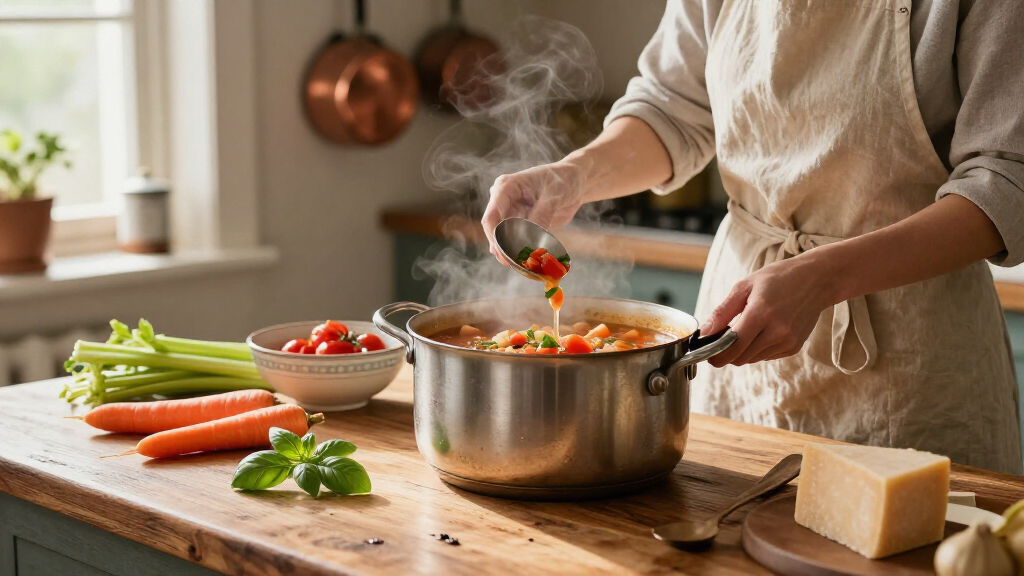
The method proceeds in six steps, with the guide stressing that order matters more than any single ingredient. The soffritto comes first: one diced onion, two carrots, and two celery stalks sweated in 3-4 tablespoons of extra-virgin olive oil over medium-low heat for 15-20 minutes, until soft but not browned. Garlic and hard vegetables such as winter squash, cabbage, or potatoes follow, then two cans of drained borlotti or cannellini beans with a ladle of tomato. The pot is filled with water or light stock and simmered 30-40 minutes with a rind of Parmigiano-Reggiano DOP, which the guide says melts into the broth and adds umami depth “most homemade minestre lack.” Soft vegetables and greens — zucchini, chard, kale, spinach — go in during the final 10 minutes to preserve color and structure.
The final step is the one the guide calls the most important for week-long storage: boil the pasta in a separate pot — ditalini or broken spaghetti — and add it to each bowl only at serving time. According to the guide, pasta left in liquid keeps absorbing broth overnight, bloating and going soft, so that “by day two your soup is starchy mush.” On storage, the guide states that minestrone keeps 4 to 5 days refrigerated in airtight containers and roughly 3 months in the freezer, provided the soup is cooled quickly — ladled into shallow containers within two hours of cooking — and reheated only in the portion being eaten, until steaming hot throughout, roughly 165°F checked with a thermometer.
Why the Pasta Rule Decides the Week
The guide matters because it addresses the single most common point of failure in make-ahead soup: storage technique. Batch cooking is widely recommended as a way to reduce food waste, cut weeknight cooking time, and lower per-meal costs, but soups with pasta routinely fail in the refrigerator — a fact that discourages home cooks from meal planning around them at all. By isolating the pasta as a serving-time addition, the method converts minestrone from a one-night dish into a four-to-six meal asset, which is the difference between a recipe and a genuine weekly system.
The approach also has practical economic value. The method uses canned beans, seasonal vegetables, water or light stock instead of expensive store-bought broth, and a cheese rind that would otherwise be discarded — a near-zero-cost flavor upgrade. For households managing grocery budgets, the guide demonstrates that a week of lunches can come from a single 90-minute session and inexpensive ingredients.
Finally, the guide preserves and transmits a traditional technique — the Italian Sunday pot, rooted in cucina povera — in a form adapted to modern food-safety guidance, including specific refrigeration, freezing, and reheating temperatures. That combination of tradition and verified storage practice is what makes the method actionable for contemporary cooks rather than merely nostalgic.
Products Worth Considering

Le Creuset Alpine Enameled Cast Iron Fondue Set, 2.5 qt., Nuit

Le Creuset Enameled Cast Iron Rectangular Roaster, 5.25 qt, Riviera

Instant Pot Pro Plus 6-Quart 10-in-1 Electric Pressure Cooker
As an affiliate, we earn on qualifying purchases.
A Regional Soup With No Fixed Recipe
Minestrone has no canonical ingredient list, the guide emphasizes, and regional variations across Italy reflect that. In Liguria, the soup is finished with a spoonful of pesto and called minestrone alla genovese. In Tuscany, it is often served with day-old bread. Southern Italian versions lean on tomatoes and summer zucchini. The name itself encodes the history: minestra means soup in Italian, and minestrone is the big, robust version — literally “big soup.”
What stays constant across regions, according to the guide, are three elements: the soffritto base, the beans (usually borlotti or cannellini), and a season-first approach. The guide treats minestrone as a seasonal template rather than a fixed recipe — spring peas, summer zucchini, and winter squash and cabbage all belong in their respective months, with the cook using whatever the market offers that week. That flexibility is presented as precisely what makes the dish suited to make-ahead cooking.
Sunday is the recommended cooking day for a practical reason: the soup needs time that weeknights cannot provide. The guide states that a proper soffritto alone requires 15-20 minutes of gentle sweating, and rushing that step produces “thin, one-dimensional broth instead of the sweet, rounded base that makes minestrone taste like someone cared.”
“Never store cooked pasta inside the soup pot. Pasta left in liquid keeps absorbing broth overnight, bloating and going soft — by day two your soup is starchy mush.”
— Mad Tasting guide
Claims From Experience, Not Lab Data
The storage and safety figures in the guide — 4-5 days refrigerated, about 3 months frozen, 165°F reheating, and the two-hour cooling window — align with widely used food-safety guidance, and the 40°F-140°F “danger zone” the guide cites is a standard reference. However, the guide’s sensory claims, such as the soup being better on day two or a spoon standing upright in a properly made pot, are presented from cooking experience rather than measured testing, and results will vary with ingredients, pot size, and heat. The exact serving count — 10 to 12 from a standard Dutch oven — also depends on portion size and the specific vegetables used. The guide’s source material was cut off mid-sentence on the effects of repeated reheating, so its full position on that point is not stated.
Taking the Template Into Each Season
For readers adopting the method, the immediate next steps are practical: assemble a soffritto trio and beans, freeze a Parmigiano-Reggiano rind in advance, and cook the week’s pasta in a separate pot on serving days. As seasons change, the guide directs cooks to swap the vegetable layer accordingly — peas in spring, zucchini and tomatoes in summer, squash and cabbage in winter — while keeping the soffritto, beans, and storage rules fixed. Cooks who want to test the day-two flavor claim can refrigerate half the Sunday pot and compare bowls on consecutive days, and anyone freezing portions should label containers with the date, since the guide’s three-month freezer window is a quality guideline rather than a hard cutoff.
Key Questions
How long does minestrone keep in the fridge and freezer?
According to the Mad Tasting guide, minestrone keeps 4 to 5 days refrigerated in airtight containers and roughly 3 months in the freezer — provided it is cooled quickly, within two hours of cooking, and the pasta is stored separately.
Why should pasta be cooked separately for minestrone?
The guide states that pasta stored in soup keeps absorbing broth overnight, bloating and turning soft, leaving a starchy mush by day two. Boiling ditalini or broken spaghetti separately and adding it to each bowl at serving time preserves the soup’s texture all week.
What does the Parmigiano-Reggiano rind do?
Simmered in the pot for 30-40 minutes, the rind melts into the broth and adds umami depth. The guide recommends keeping rinds in a freezer bag, since they would otherwise be discarded and cost nothing.
How many meals does one Sunday pot produce?
The guide estimates 90 minutes of mostly hands-off cooking yields 10 to 12 servings from a standard Dutch oven — dinner plus several lunches, with leftovers for later in the week or the freezer.
Is there one authentic minestrone recipe?
No. The guide states there is no canonical ingredient list: Liguria finishes the soup with pesto, Tuscany pairs it with day-old bread, and southern versions lean on tomatoes and zucchini. The constants are the soffritto, the beans, and using seasonal vegetables.
Source: Mad Tasting